Jobtrailguide
How to Work a Job Fair: Steps (With Scripts)
Most of the value sits in the week before the doors open and the 24 hours after you leave, not in the two minutes you spend at the table.
By Wei Chen · Published · Updated · 15 min read
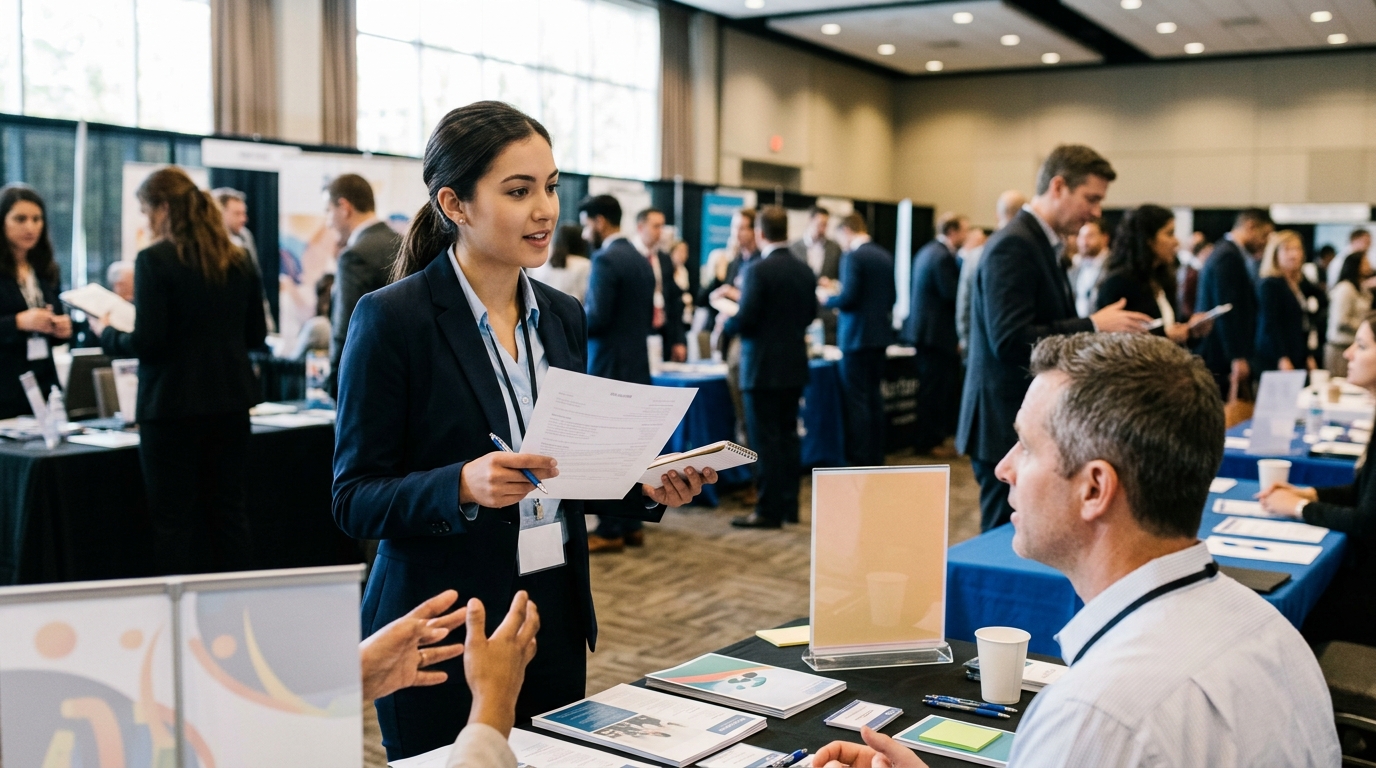
Working a job fair well comes down to three things: researching the exhibitor list and setting a clear career objective before you go, delivering a short practiced introduction at the table, and following up in writing while the recruiter still remembers the conversation. CareerOneStop, run by the U.S. Department of Labor, advises not to expect an on-the-spot interview or a job offer, but to be prepared for an interview just in case.
The people at the booths are usually recruiters rather than the person with hiring authority (CareerOneStop (U.S. Department of Labor), undated), so treat the fair as the first step in a process you control afterwards.
When to do it, and when to wait
Go to a fair when it moves something forward. Here are the signals that it will, and one that says wait.
- The published exhibitor list has three or more employers you would actually apply to. CareerOneStop's before-the-fair checklist puts researching participating employers near the top of the list (CareerOneStop (U.S. Department of Labor), undated). If the list is not published, email the organizer and ask for it. If three names do not stand out, your time is better spent applying directly.
- You can say your career objective in one sentence. CareerOneStop tells job seekers to arrive with a stated career objective and an introduction describing their job goal plus three or four of their best skills and experiences (CareerOneStop (U.S. Department of Labor), undated). If you can say "I'm looking for [role] work in [field]", you are ready to use a booth well.
- You are new to a city, state or industry and need contacts fast. A fair compresses twenty introductions into three hours. That is hard to replicate any other way.
- The hiring cycle is about to open. Seasonal hiring, campus recruiting seasons, and hiring events run by state workforce agencies cluster at predictable times of year, and these vary by state and by employer. Ask the organizer when the listed employers expect to post roles.
- You want practice before interviews. Saying your introduction out loud to eight strangers is rehearsal with stakes, and CareerOneStop recommends practicing the elevator speech out loud with confidence beforehand (CareerOneStop (U.S. Department of Labor), undated).
Not yet: if your resume has not been updated since your last job and you cannot get copies printed before the date, wait for the next event. Walking in with nothing to hand over, or with a document that contradicts what you say at the table, costs you the contact rather than building one. Fairs repeat — most organizers run them at least annually, and larger metro areas run them far more often.
Step by step
- Register in advance and plan your route. CareerOneStop's checklist lists registering ahead and planning how to get there among the first tasks (CareerOneStop (U.S. Department of Labor), undated). Some fairs cap attendance, some require a ticket at the door, and virtual fairs usually need an account on the host platform plus a test of your camera and microphone. Lead time: 1–2 weeks before, or as soon as registration opens.
- Build a shortlist from the exhibitor list. Open the organizer's employer list and mark your top 8–12, grouped into "must speak to", "worth a look" and "warm-up". Note one specific thing about each — a location, a team, a posted opening. Lead time: 7–10 days before.
- Tailor and print your resume. Advice on quantity varies by career center: at least two copies per organization you plan to visit (Ohio State University Career Counseling and Support Services, undated), 10–15 copies (Florida International University Career Services Blog, undated; University of Cincinnati Career Co-op Support, undated), or 15–20 for in-person fairs (University of Texas at Dallas Career Center, undated). CareerOneStop simply says to polish it and bring several copies in a folder, along with pen and paper (CareerOneStop (U.S. Department of Labor), undated). Print on clean, quality paper (Cincinnati State Career Center, undated). Lead time: 3–5 days before, so you are not at a print shop on the morning.
- Write and rehearse a 30–60 second introduction. It should open with a firm handshake, eye contact and a clear voice, then your name and career objective (CareerOneStop (U.S. Department of Labor), undated). A career advisor quoted by Virginia Tech describes elevator pitches as running 30 seconds to a minute (Virginia Tech News, September 2024), and other guides agree on roughly 30 seconds to one minute (Yoodli, undated) or 60 seconds or less (University of Texas at Austin, CNS Career Services, undated). Preparing one makes you more confident and produces better results when networking (CareerOneStop (U.S. Department of Labor), undated). Lead time: 3–4 days, practiced out loud daily.
- Write down your questions. CareerOneStop's checklist includes making a list of questions to ask (CareerOneStop (U.S. Department of Labor), undated). Three good ones: what roles are opening in the next quarter, what the application route is, and what separates candidates who get interviews. Lead time: 2 days before; keep them in the folder with your resumes.
- Sort out clothes and the bag the night before. For in-person fairs, business professional attire — a suit, dress pants, blazer or dress — is the standard advice (University of Cincinnati Career Co-op Support, undated), and jeans, t-shirts, hooded sweatshirts and hats are what to avoid (Cincinnati State Career Center, undated). Expectations do shift by industry and region, so if the organizer states a dress code, follow it. Pack resumes in a folder, pen and paper, and water. Lead time: the evening before.
- Work the room in order on the day. Start at a warm-up booth to shake off nerves, then your must-speak list. After each conversation, step aside and take notes — on your phone or on paper (CareerOneStop (U.S. Department of Labor), undated) — about the role discussed, the name, and what you agreed to do next. Ask for a business card and note any follow-up you want to do (CareerOneStop (U.S. Department of Labor), undated). Be ready in case a recruiter pulls you into a screening conversation on the spot, but do not count on it (CareerOneStop (U.S. Department of Labor), undated). Time needed: 2–3 hours for a mid-size fair.
- Apply formally and send follow-up emails. Advice on timing varies: within 24 hours while the recruiter still remembers the conversation (Enhancv, undated), a day or two after speaking with employers or new connections (Wentworth Institute of Technology Co-ops and Careers, undated), or the same or next day when a specific job opportunity is involved and up to a week later if the goal is networking (University of Utah Career Success, undated). Submit the application through the employer's own careers system as well — a resume handed over at a booth is rarely in their applicant tracking system. Lead time: block 90 minutes the evening of the fair or the next morning.
What to say
Use these as a frame, not a recital. Swap the bracketed parts for your own details and say them out loud a few times before the event.
The 30–60 second introduction at the booth
Spoken, at the table
"Hi, I'm [your name]. I'm a [current role or field, e.g. warehouse supervisor] looking for [target role] work in [city or region]. For the last [number] years I've done [skill one], [skill two] and [skill three] — most recently I [one specific result, e.g. ran the night shift for a 40-person team]. I saw you have [specific team, site or role] here, so I wanted to ask what you're hiring for in the next few months."
That covers your job goal and three or four of your best skills, which is what CareerOneStop recommends (CareerOneStop (U.S. Department of Labor), undated), and it ends with a question so the recruiter talks next.
Closing the conversation and getting the contact
Spoken, as you wrap up
"That's helpful, thank you. Do you have a card, or is there an email I can send my resume to? And just so I get it right — should I apply through [careers site] first, or send it to you directly? I'll follow up [today / tomorrow] with [the thing you mentioned, e.g. my certification details]."
The follow-up email
Subject: [Job fair name], [date] — [your name], [target role]
Hi [recruiter first name],
We spoke at [job fair name] on [day] about [specific role or team]. You mentioned [detail they told you, e.g. that the [site] team opens applications in [month]] — thank you for explaining how that works.
I've attached my resume. The short version: [number] years in [field], with [skill one] and [skill two], and I [one specific result]. I've also submitted an application for [req number or job title] through [careers site], as you suggested.
If it would help to talk further, I'm available [two or three concrete windows]. Either way, I'd welcome being kept in mind for [type of role] in [location].
Thanks again, [Your name] — [phone] — [email] — [LinkedIn or portfolio URL]
When they say they are not hiring right now
Spoken, at the table
"Understood. Two quick things, then I'll let you get on: when does that usually open up again, and is there anyone on the [team or department] side you'd suggest I speak to in the meantime? I'll keep an eye on [careers site] either way."
If pay comes up before you are ready
Spoken, if asked what you are looking for
"I'm targeting the market range for [role] in [metro area] — based on what I've seen, somewhere around [$X] to [$Y], and I'd rather firm that up once I understand the scope and the schedule. What range is this position budgeted at?"
Build that range before the fair from published postings for the same title and location, and from public wage data such as the Bureau of Labor Statistics Occupational Outlook Handbook and your state workforce agency's wage pages. Pay structures differ widely — hourly with shift differentials, salaried with a bonus, commission, or union scales set by contract — so what you quote should match how that job is actually paid.
Mistakes to avoid
| Mistake | Why it backfires |
|---|---|
| Expecting an interview or an offer on the day | CareerOneStop is direct about this: do not expect on-the-spot interviews or a job offer, though you should be prepared for an interview just in case (CareerOneStop (U.S. Department of Labor), undated). If you arrive expecting a decision, you will come across as pushy at the table and read a normal "apply online" as a rejection. |
| Treating the recruiter as the decision-maker | The people you meet at fairs are generally recruiters rather than people with hiring authority, which makes the fair a first step (CareerOneStop (U.S. Department of Labor), undated). Pressing for a yes wastes the two minutes you had to make them remember you to the hiring manager. |
| Asking "so what does your company do?" | Researching participating employers is on the pre-fair checklist for a reason (CareerOneStop (U.S. Department of Labor), undated). The question tells a recruiter you picked the booth at random, and it burns the time you could have spent on roles, timelines and application routes. |
| Handing the same generic resume to everyone, and nothing else | Volume without targeting produces a pile of paper nobody can match to a role. Worse, if you do not collect business cards and note the follow-up you want to do (CareerOneStop (U.S. Department of Labor), undated), you have no way to reach anyone afterwards — and the follow-up is where fairs actually pay off. |
| Dressing casually for an in-person fair | Jeans, t-shirts, hooded sweatshirts and hats are what career centers tell people to leave at home (Cincinnati State Career Center, undated), with business professional attire — a suit, dress pants, blazer or dress — the usual advice (University of Cincinnati Career Co-op Support, undated). Standards vary by industry and region, but at a fair you are being compared side by side with everyone else in the line. |
| Opening with pay, benefits or relocation | Those questions are legitimate and you should get answers before you accept anything. Asked first, at a booth, in front of a queue, they signal that you have not yet decided whether you want the work. Save them for the recruiter screen, and arrive with your own researched range. |
| Skipping notes between booths | By booth number nine, conversations blur. CareerOneStop advises being ready to take notes with your phone or pen and paper (CareerOneStop (U.S. Department of Labor), undated). Without them your follow-up email says nothing specific, and a generic email is indistinguishable from the hundred other generic emails that recruiter is reading. |
The honest downside: plenty of fairs under-deliver. Some exhibitors attend for employer branding rather than live openings, some booths are staffed by people who will not be involved in hiring at all, and some events are heavily weighted to one or two industries that may not be yours. You can only find that out by reading the exhibitor list first and by asking, at each booth, what is actually open.
If the answer is no
"No" at a fair usually looks like silence after your follow-up email, or a recruiter telling you nothing is open. Here is a sequence that keeps the contact useful.
- Within 24–48 hours: send the follow-up email anyway, even to the recruiters who said they were not hiring. Timing guidance runs from within 24 hours (Enhancv, undated) to a day or two afterwards (Wentworth Institute of Technology Co-ops and Careers, undated). Submit formal applications through each employer's own careers system the same evening, since a booth resume often never enters the system.
- Within one week: for contacts where the goal was networking rather than a specific job, a follow-up up to a week later is reasonable (University of Utah Career Success, undated). Connect on LinkedIn with a one-line reminder of where you met. Set a calendar reminder for the month the recruiter named as the next hiring window.
- Week 2: send one short nudge to anyone who discussed a live role and has not replied — three sentences, no apology, re-attaching the resume. One nudge. After that, let it sit.
- Weeks 2–4: ask two of the friendlier contacts who else you should be talking to, and request a 15-minute informational call with someone on the team you want to join. This is where most fair contacts turn into something, and it is slower than people expect.
- Weeks 3–6: review your targeting rather than your effort. If five recruiters all said your background points somewhere different from where you applied, that is data. Compare your target titles against job descriptions for the same role and against the Bureau of Labor Statistics Occupational Outlook Handbook for what the work typically requires, and rewrite your one-sentence career objective to match.
- Months 2–3: attend the next relevant fair with a revised resume and a tightened introduction. Your state workforce agency's job centers and CareerOneStop, run by the U.S. Department of Labor, list local hiring events, and availability varies a lot by state and metro area. Virtual fairs can fill the gap if in-person events near you are thin.
- Ongoing: keep a simple tracker — employer, recruiter name, date met, what was said, follow-up sent, next check-in. Six months later, when the req finally opens, the person who emails with "we met at [fair] in [month] and you mentioned this would open in the spring" is in a different category from a cold applicant.
Frequently asked questions
How much should I say I want to be paid if a recruiter asks at the booth?
Give a researched range rather than a single number, and say you would firm it up once you know the scope, schedule and location. Build the range before the fair from current postings for the same title in the same metro area, plus public wage data such as the Bureau of Labor Statistics Occupational Outlook Handbook and your state workforce agency's wage pages. Pay structure matters as much as the number: hourly roles may carry shift differentials and overtime, salaried roles may carry bonuses, sales roles may be largely commission, and union-covered jobs may follow contract scales. Asking what range the position is budgeted at is a normal question to return.
When exactly should I send the follow-up email?
Soon. One guide says within 24 hours, while the recruiter still remembers the conversation (Enhancv, undated); another suggests a day or two after speaking with employers or new connections (Wentworth Institute of Technology Co-ops and Careers, undated). The University of Utah's career service splits it by situation: same day or next day when a specific job opportunity is involved, and up to a week later when the main goal is networking (University of Utah Career Success, undated). If you only have time for one thing the night of the fair, email the two or three contacts who mentioned a live opening.
How many copies of my resume should I bring?
It depends on how many employers you plan to visit, and career centers differ. One approach is at least two copies per organization you intend to speak with (Ohio State University Career Counseling and Support Services, undated). Others give flat numbers: 10–15 copies (Florida International University Career Services Blog, undated; University of Cincinnati Career Co-op Support, undated) or 15–20 for in-person fairs (University of Texas at Dallas Career Center, undated). Print them on clean, quality paper (Cincinnati State Career Center, undated) and carry them flat in a folder with pen and paper (CareerOneStop (U.S. Department of Labor), undated).
Should I still apply online if I handed my resume to a recruiter?
Yes. Paper collected at a booth often does not reach the employer's applicant tracking system, and recruiters frequently ask candidates to apply through the official careers site so the application is attached to a requisition number. Apply the same day, then mention the requisition number or job title in your follow-up email so the recruiter can find your file.
Is it worth going if the people at the booths cannot hire me?
Usually yes, as long as you treat it as step one. The people you meet are generally recruiters rather than those with hiring authority (CareerOneStop (U.S. Department of Labor), undated), but recruiters control who gets passed to the hiring manager, know when requisitions open, and can tell you which route into the company actually works. What makes the trip worthwhile is leaving with names, contact details and notes on what to do next (CareerOneStop (U.S. Department of Labor), undated) — not with a decision.
Sources
- CareerOneStop (U.S. Department of Labor) — Job Fairs
- CareerOneStop (U.S. Department of Labor) — Visit a job fair