Jobtrailguide
Jobs in the USA: Find Open Positions Across Dozens of Industries in 2026
A practical walk-through of how US hiring works across industries — what employers screen for, what to have ready, and where openings actually get posted.
Published · 7 min read
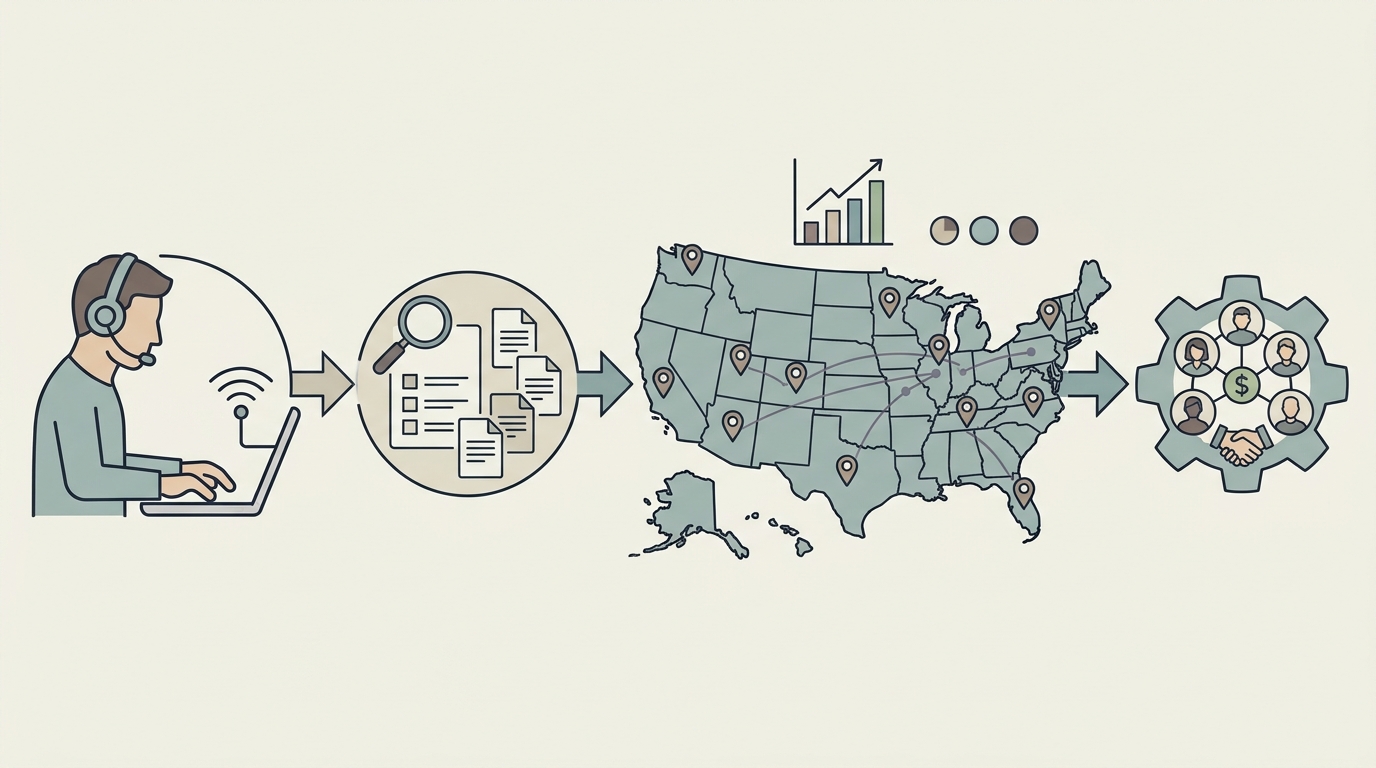
Hiring in the United States runs on a mix of national job boards, employer career pages, staffing agencies and state workforce agencies, and the same basic sequence works across most industries: pick two or three realistic job titles, match your application to how those roles are actually described, then apply steadily and follow up. Entry-level operational work — warehousing, logistics, retail stocking, production support — is usually the fastest door in, because much of it is learned on the job rather than in a classroom.
This guide walks you through the steps to a first role, what to have ready before you hit submit, and where openings are commonly posted. Requirements, pay and licensing vary by employer and by state, so verify details against official sources before you rely on them.
Your step-by-step path to a first role
- Choose two or three target job titles, not a vague field. Employers post by title. For entry-level material handling, reported titles include Laborer, Loader, Material Handler and Warehouse Worker (O*NET OnLine, U.S. Department of Labor, undated); a closely related option is stocker and order filler, which covers receiving, storing and issuing merchandise and may involve operating power equipment, marking prices and setting up displays (CareerOneStop, U.S. Department of Labor, undated).
- Read the official occupation profile for each title. Look up your chosen titles on O*NET and CareerOneStop to see typical tasks, and check the Occupational Outlook Handbook for projected openings and outlook over the decade (U.S. Bureau of Labor Statistics, 2025). This tells you which duties to put at the top of your resume.
- Check the physical and education requirements honestly. For many entry-level handling jobs there are no formal education requirements, and employers commonly require workers to be able to lift a certain weight, with repetitive movement and heavy lifting as part of the work (CareerOneStop, U.S. Department of Labor, undated). Entry-level education is typically no formal credential, with training given on the job (U.S. Bureau of Labor Statistics, 2025).
- Write one resume per target title. One page. Use the employer's own words for duties — moving freight and stock, sorting cargo, attaching identifying tags, recording units handled — and give volumes, shift lengths and equipment used where you can.
- Line up training that unlocks more roles. Forklift work is a common step up: under the powered industrial truck standard, employers must ensure each operator completes training and is evaluated before operating independently (Occupational Safety and Health Administration, undated). Ask in interviews whether that training is provided in-house.
- Apply in batches and track them. Send 10 to 15 tailored applications a week through a mix of channels rather than one. Record the employer, date, title and contact in a simple spreadsheet.
- Prepare for a short screening call. Expect questions on availability, lifting, reliability and transport. Most of this work is full time, shifts longer than eight hours are common, and some warehouse roles run overnight because materials ship around the clock (U.S. Bureau of Labor Statistics, 2025).
- Follow up once, five to seven business days after applying. Email or call the hiring contact, restate the exact job title and reference number, and confirm you're still available for the shifts listed.
What to prepare before you apply
- A one-page resume per target title, with duties phrased the way employers and O*NET describe them, and a plain-text version you can paste into online forms.
- A complete work history list: employer names, cities, job titles, start and end months, and a phone number or email for each. Online applications ask for this and reject incomplete entries.
- Two or three references — a former supervisor is strongest — whom you have asked in advance and whose current phone and email you have confirmed.
- Copies of any certificates or training records you already hold, including safety training, equipment operation, food handling or first aid, scanned as PDFs.
- The documents employers ask for at onboarding, including photo ID and the paperwork used to verify employment eligibility. Have originals accessible; check the employer's own onboarding instructions for exactly what they require.
- Your real availability in writing: days, earliest and latest hours, overnight or weekend willingness, and how you'll get to the site. Deciding this before an interview stops you accepting a schedule you can't keep.
- A professional email address and a clear voicemail greeting. Screening calls often come from unknown numbers within days of applying.
Where to look for openings
- Your state workforce agency job bank and local American Job Center. These are public, free, and list local employers; CareerOneStop (U.S. Department of Labor) is the federal gateway to state services, education requirements and state licensing board information (U.S. Bureau of Labor Statistics, 2025).
- Large national job boards and aggregator sites, filtered by commute distance, shift and title. Save searches for each of your two or three target titles and turn on daily alerts.
- Employer career pages for distribution centers, plants, hospitals and retailers in your area. Many high-volume sites post and hire directly, and some run walk-in or same-day hiring events.
- Staffing and temp-to-hire agencies specializing in light industrial, logistics or clerical placement. Register in person or online; agencies often fill short-notice shifts and can lead to permanent roles.
- Trade associations and local chambers of commerce, which run member job boards and industry hiring events that never reach the big aggregators.
- Union hiring halls and registered apprenticeship listings, searchable through your state workforce agency, for construction, transportation and skilled trades entry points.
- Community college and workforce training career offices, which often hold employer relationships and on-campus hiring days open to local job seekers, not only students.
Frequently asked questions
Do I need a degree or certificate to get an entry-level role?
Often not. For hand laborers and material movers, typical entry-level education is no formal educational credential, with short-term on-the-job training provided after hire (U.S. Bureau of Labor Statistics, 2025), and CareerOneStop notes no formal education requirements for this kind of work (U.S. Department of Labor, undated). Requirements still vary by employer and state, so read each posting.
Do I need forklift certification before I apply?
Not necessarily. Under the OSHA powered industrial truck standard, the employer must ensure each operator completes training and is evaluated before operating a forklift independently (Occupational Safety and Health Administration, undated), so many employers train in-house. If you already have training records, attach them — it widens the roles you can be considered for.
How is pay usually structured, and where do I check current rates?
Most entry-level operational jobs pay an hourly rate, sometimes with shift differentials for nights or weekends. Under the Fair Labor Standards Act, covered nonexempt employees must receive overtime of at least one and one-half times their regular rate after 40 hours in a workweek (U.S. Department of Labor, Wage and Hour Division, undated). Some roles, such as grocery baggers or carwash attendants, may receive tips (U.S. Bureau of Labor Statistics, 2025). For current figures, check the Occupational Outlook Handbook and CareerOneStop's local wage data for your area.
What shifts should I expect to be offered?
Most hand laborers and freight, stock and material movers work full time, shifts longer than eight hours are common, and some warehouse workers work overnight because materials are shipped around the clock (U.S. Bureau of Labor Statistics, 2025). Ask at the screening stage which shift the posting is for, and whether it rotates.
Is a license required?
No federal license is required for general material handling work itself, and information on state licensing board requirements is available through CareerOneStop (U.S. Bureau of Labor Statistics, 2025). Related driving roles have their own requirements — heavy and tractor-trailer truck driving typically calls for a postsecondary nondegree award (U.S. Bureau of Labor Statistics, 2025). Check your own state's rules before paying for any training.