Jobtrailguide
How Long Does It Take to Become a Cosmetologist?
Training hours, exam scheduling and license processing all stretch the timeline — here is what sets the clock, and where to check your state's rules.
By Marisol Andrade · Published · Updated · 12 min read
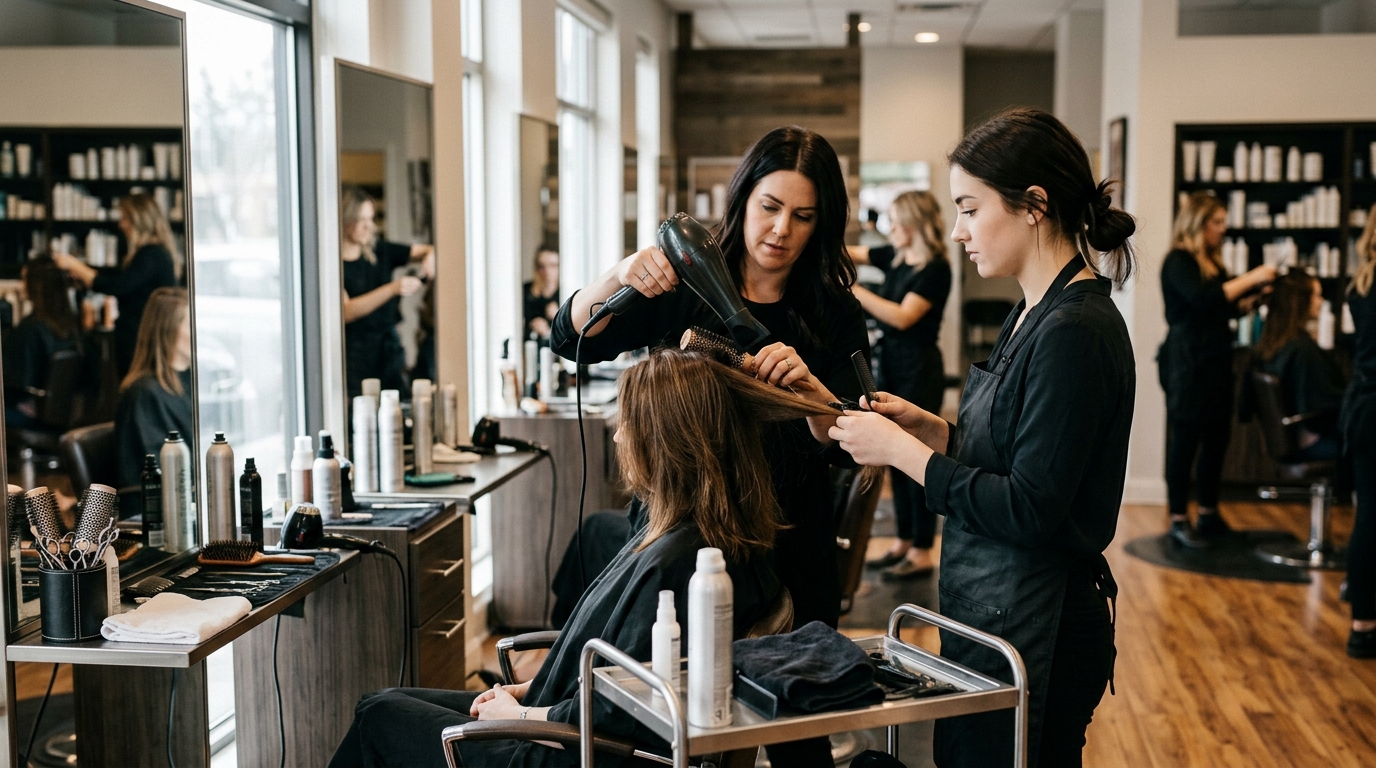
Most people go from first day of school to licensed cosmetologist in roughly nine to fifteen months of full-time training. Part-time and evening programs usually stretch that to about eighteen months to two years. The clock is set mainly by the training hours your state board requires, how many hours a week your school schedules, and how long you wait for an exam date and license processing afterwards.
Hours requirements vary a lot by state — some require around 1,000, others closer to 1,500 or 1,600 — so the honest answer depends on where you plan to be licensed. Check your state board of cosmetology's website before you compare any two schools.
What a cosmetologist does (list)
A cosmetologist performs licensed hair, skin and nail services, within the scope your state license allows. A typical day is a mix of hands-on service work, consultation and cleaning.
- Consults with clients before every service: asking what they want, checking hair condition and history, and setting expectations about what's possible in one appointment.
- Cuts and styles hair using shears, razors, clippers and thermal tools — everything from a basic trim to fades, layers, blowouts and event styling.
- Mixes and applies color: single-process, highlights with foils, balayage, toners and corrective work, choosing developer volume and timing for each head of hair.
- Performs chemical services such as perms, relaxers and smoothing treatments, including strand tests and timing checks.
- Shampoos, treats and conditions hair at the bowl, and may do scalp treatments, basic skin or nail services depending on the license and the salon.
- Cleans and disinfects constantly: tools in an EPA-registered disinfectant solution, station wiped between clients, floors swept, laundry run, dispensary restocked.
- Books, rebooks and records: entering formulas in client notes, taking payment, rebooking the next visit, and recommending retail products.
Where they work: commission salons, booth-rental salons, franchise chains, barbershops, blow-dry bars, spas and resorts, hotels, cruise ships, nursing homes, film and theatre, and mobile or home-based work where state rules allow it.
A typical schedule: salons live on evenings and weekends. Expect Tuesday-to-Saturday weeks, late nights midweek, and Saturdays as the busiest day. Many stylists work four long days rather than five short ones. You will be on your feet for most of a shift, with gaps between appointments early in your career and almost none once you're booked. Booth renters set their own hours but carry their own slow weeks.
The honest downside: the physical toll is real — feet, back, shoulders, wrists — and so is the skin sensitivity some people develop from constant exposure to water, color and cleaning chemicals. Income is uneven for the first year or two while you build a client list. And a fair number of graduates leave within a few years because evenings and weekends don't fit their lives.
How to become one (steps)
- Confirm your state board's requirements first. Open your state board of cosmetology's licensing page and write down the required training hours, the minimum age, and whether a high school diploma or GED is needed. Takes an afternoon and costs nothing. This single page decides how long your training will take — a 1,000-hour state and a 1,600-hour state are months apart.
- Tour two or three state-approved schools and ask for their consumer disclosures. Ask each one for its published completion rate, licensing exam pass rate and job placement figures, plus the full catalog. Allow two to four weeks. Ask to watch the student clinic floor on a busy afternoon — that's where you'll spend most of your hours.
- Price the whole program, not the tuition line. Add kit, textbooks, exam fees and license application fees to the tuition. Totals commonly run from a few thousand dollars at a community college to the high teens or more at a private academy; the spread is driven by school type, program length and what's bundled into the kit. Submit the FAFSA if the school participates in federal aid, and ask the financial aid officer directly which costs it covers.
- Enroll and start logging clock hours. Full-time programs typically run nine to fifteen months; part-time and evening tracks eighteen months to two years. Early weeks are theory and mannequin-head practice — cutting, sectioning, roller sets — before you touch a paying client.
- Build real speed on the student clinic floor. From roughly the midpoint of your program you'll take walk-in clients at reduced prices. Treat it as a job: track your timings, keep written color formulas, and photograph consistent before-and-after shots in the same lighting for a portfolio you can show salon owners.
- Apply for and sit the licensing exam. Most states use a written theory exam plus a practical exam, and many use exams administered through the National-Interstate Council of State Boards of Cosmetology (NIC). Application, scheduling and sitting both parts commonly takes two to eight weeks after you finish hours; fees are set by your state and the testing vendor, so check both fee schedules. Practice the practical on a mannequin against a timer — it's graded on sanitation and procedure as much as the result.
- Submit your license application and wait on processing. Boards generally need proof of hours from your school, exam results and a fee. Processing is often two to eight weeks, sometimes longer at busy times of year. Don't book a start date that assumes same-week approval.
- Line up an assistant or junior stylist role before you graduate. Talk to the salon manager, not the front desk, and ask to shadow for a day. Ask what their assistant program looks like, how long it lasts, and how someone moves to taking their own clients. Start this two to three months before your last day of school.
What goes wrong: running out of money partway through and having to pause (hours can expire in some states), underestimating how many hours are left when you switch to part-time, failing the practical because of sanitation errors rather than technique, and graduating with no clients and no plan for building them.
Skills you'll need (list)
Technical skills
- Cutting: sectioning, elevation and over-direction with shears, a razor and clippers — including clipper-over-comb and fades, which many graduates are weak at and which salons ask about.
- Color: reading natural level and underlying pigment, mixing with the right developer volume, foiling and balayage placement, toning, and safe lightener application with strand tests.
- Chemical texture: perms, relaxers and smoothing services, including patch and elasticity testing and knowing when to refuse a service on compromised hair.
- Thermal and finishing work: round-brush blowouts, flat iron and curling wand technique, and styling textured hair without damage.
- Sanitation and infection control: correct use of an EPA-registered hospital-grade disinfectant, implement storage, laundering rules and your state's specific sanitation code. This is graded on your practical exam and inspected in salons.
- Booking and records: using salon booking and point-of-sale software for appointments, deposits, client notes and formula history.
Soft skills, and how to show them
- Consultation. Show it by repeating the client's request back in your own words and naming one thing you'd do differently and why, before you pick up a tool.
- Time management. Show it by finishing a full color-and-cut within the booked window during school clinic, and keeping a log of your service times.
- Resilience to criticism. Show it by asking a senior stylist to critique one haircut a week and redoing it, rather than defending it.
- Selling without pressure. Show it by recommending one product tied to the problem the client raised, and recording whether they bought it and came back.
- Reliability. Show it by never missing a clinic shift and tracking your own attendance — salon owners ask about it, because no-shows cost them clients.
Pay and outlook (prose)
Cosmetology pay is structured in a few distinct ways, and which one you're on matters more early on than how good you are. Common arrangements are hourly or hourly-plus-commission, straight commission on services and retail, a sliding commission scale that rises as your service revenue grows, and booth rental, where you pay the salon a fixed weekly or monthly fee and keep what you earn. Tips are a meaningful part of total income for most stylists. Assistants are often paid hourly while they train, with no service income of their own.
What drives earnings: the size and loyalty of your repeat clientele, your rebooking rate, whether you offer higher-priced specialty services such as color correction, extensions or textured-hair work, retail sales, the price point of the salon, and the local market — a dense metro with high service prices looks nothing like a small rural town. Working weekends and evenings matters too, because that's when most clients book. Booth renters can earn more per service but carry their own supplies, insurance, marketing and slow weeks, and are responsible for their own taxes.
Demand is tied to population, local disposable income and competition. Services like cuts and color are repeat purchases on a four-to-twelve week cycle, which makes the work steadier than many retail jobs, but new graduates still compete for chairs in desirable salons. Turnover in the industry is high, which means openings exist — and also means plenty of people try it and leave.
For current national and state figures, check the U.S. Bureau of Labor Statistics Occupational Outlook Handbook entry for barbers, hairstylists and cosmetologists, and the BLS Occupational Employment and Wage Statistics pages for your metro area. For licensing fees and renewal costs, use your state board of cosmetology's published fee schedule rather than a school's estimate.
Career path (timeline)
| Stage | Typical titles | Usual time at this stage |
|---|---|---|
| Entry | Assistant, shampoo technician, apprentice stylist, junior stylist | 6 months to 2 years |
| Mid | Stylist, colorist, barber-stylist, booth renter | 2 to 5 years |
| Senior | Senior or master stylist, color specialist, lead stylist, salon manager | 5 to 10 years |
| Beyond the chair | Salon owner, educator, platform or session artist, product-line trainer, licensed instructor, state board inspector | 7 years and up |
Entry (year 0-2). Most new licensees start as an assistant: shampooing, applying color under supervision, folding foils, cleaning, and taking a small number of their own clients on quiet days. Some salons run structured assistant programs with weekly training nights. This stage is where you learn speed and salon etiquette — and where pay is lowest.
Mid (year 2-5). You take a full column of your own clients and your rebooking rate becomes the number that matters. Many stylists specialise here: blonding, color correction, curly cutting, extensions, or barbering. Some move to booth rental for control over hours and pricing, which means running a small business and handling your own bookkeeping and taxes.
Senior (year 5-10). A full, mostly rebooked schedule, a waiting list, higher prices, and often responsibility for training assistants. Salon manager roles add scheduling, hiring, inventory and retail targets to the job, usually with reduced time behind the chair.
Beyond the chair. Owning a salon or suite, teaching in a cosmetology school (most states require a separate instructor license with its own hours and exam), working as an educator for a product line, doing session work for photo, film or theatre, or inspecting salons for a state board. Each of these needs something extra — capital, an instructor credential, a portfolio, or state employment — so plan for it a year or two ahead rather than drifting into it.
Frequently asked questions
How long does it actually take, start to finish?
For a full-time student, budget nine to fifteen months of school, then two to eight weeks to apply for and sit the written and practical exams, then two to eight weeks for your license to be issued. That puts most people at roughly twelve to eighteen months from first day of class to first day behind a chair. Part-time or evening study usually doubles the school portion. The biggest variables are your state's required training hours, how many hours a week your program schedules, and exam availability in your area.
Do I need a college degree?
No. Cosmetology is a licensed trade, not a degree field. States typically require you to be a minimum age and to hold a high school diploma or GED — though the education requirement differs by state, so confirm it with your state board. What you do need is completion of a state-approved program (or a registered apprenticeship, where your state allows one) and a passing score on the licensing exam. Some community colleges wrap cosmetology into an associate degree, which takes longer and is optional, not required.
Can any of this be done remotely?
The theory portion — anatomy, chemistry, sanitation law, business — is sometimes delivered online or hybrid, depending on the school and what your state board allows. The practical hours cannot be done remotely; you need supervised time on mannequins and live clients to earn clock hours. After licensing, the work itself is hands-on, though some stylists add remote income through online education, content or consultations. Continuing education for renewal is often available online where a state requires it.
Can I speed the training up?
Somewhat. Attending full-time rather than part-time is the main lever, and some schools offer accelerated schedules with longer days. A few states let you count hours from a related program or a prior license toward the total, and some allow apprenticeship hours in a salon instead of school. Do not assume any of this — ask your state board in writing, and ask the school's registrar what happens to your hours if you have to pause. In some states, completed hours expire after a set period.
What if I want to work in a different state later?
Licenses are issued state by state, and the hours and exams that qualify you in one state may not match another's. Most boards have a process for stylists licensed elsewhere, which may involve extra hours, an exam, or documentation from your original school and board. Before you move, contact the board in the destination state and ask exactly what they need from you, and keep your school transcript and hour records — you'll be asked for them years later.

Written by
Marisol Andrade
Marisol steers Jobguidedaily's coverage of career pivots and the messy middle of working life. She's drawn to the moment someone realizes their job title no longer fits who they are, and what they do next.