Jobtrailguide
How to Become a Welder (Steps, Skills and Pay)
A plain look at the trade: torch time, certification tests, shift patterns and the physical toll, so you can judge the work before you enroll.
By Wei Chen · Published · Updated · 13 min read
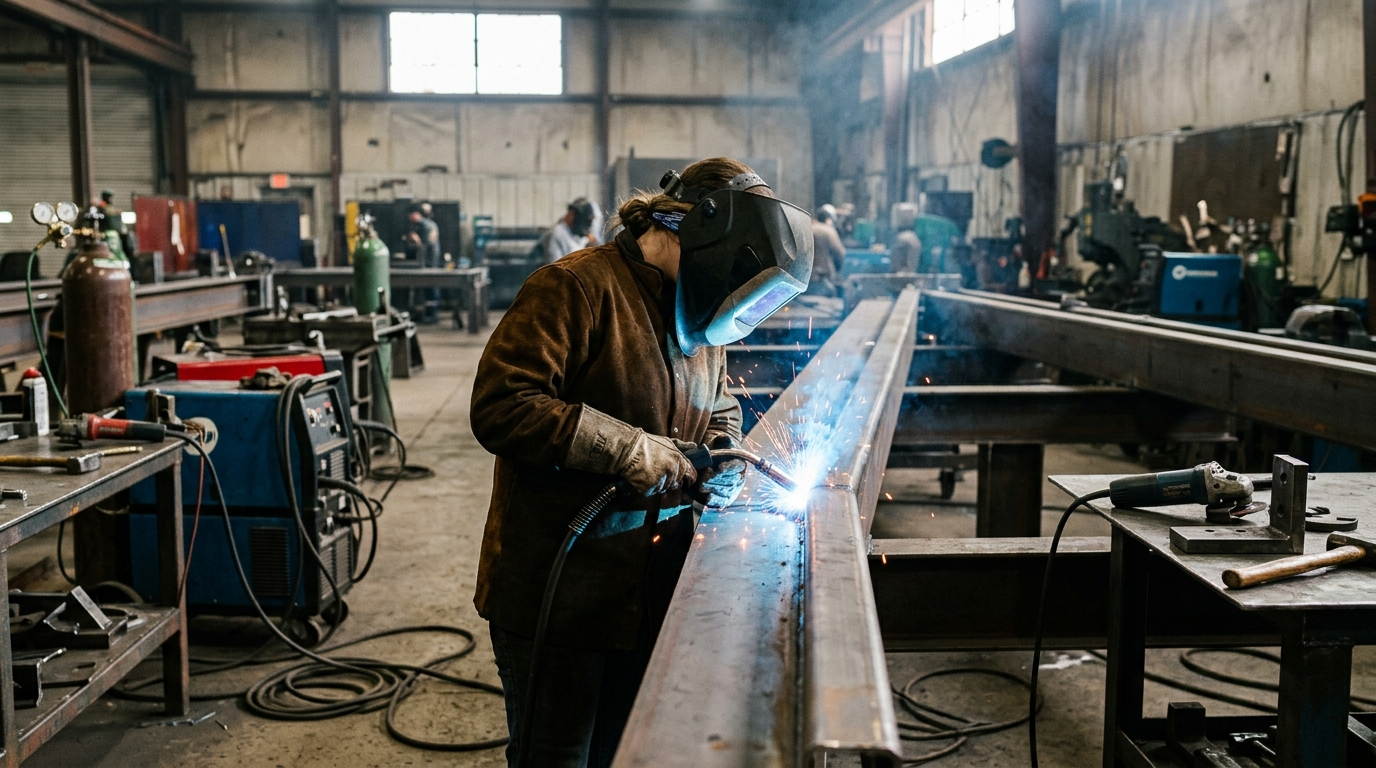
Becoming a welder usually means finishing high school or an equivalent, taking a welding certificate or associate's program, passing a hands-on weld test, and then learning the rest on the job. The U.S. Bureau of Labor Statistics (2025) lists typical entry-level education for welders, cutters, solderers and brazers as a high school diploma or equivalent, with no prior work experience required and moderate-term on-the-job training.
The quickest route is a short certificate and a performance-based certification; the slower route is a two-year associate's degree that also covers blueprint reading, metallurgy and inspection. Both end in the same place: someone watching you lay a bead and deciding whether it passes.
What a welder does (list)
A welder joins metal components with hand-welding, flame-cutting, hand-soldering or brazing equipment, and fills holes, indentations or seams in fabricated metal products (O*NET OnLine, 2026). The daily work is a loop of reading, prepping, welding and checking.
- Read blueprints, sketches and specifications, then calculate and measure the dimensions of the parts to be joined (U.S. Bureau of Labor Statistics, 2025). A misread symbol costs more time than a bad bead.
- Prepare the surfaces: grind off scale, slag, rust, moisture and grease before any arc is struck (O*NET OnLine, 2026). Prep is often a third of the job.
- Select and install torches, torch tips, filler rods and flux according to welding chart specifications (O*NET OnLine, 2026), and set amperage, voltage and gas flow on the machine.
- Weld components in flat, vertical or overhead positions (O*NET OnLine, 2026) to blueprint specifications, monitoring the process and adjusting heat as necessary (U.S. Bureau of Labor Statistics, 2025).
- Cut and trim metal to dimension using an electric arc, ionized gas plasma or burning gases, and dismantle large objects — closely related work usually done by the same person (U.S. Bureau of Labor Statistics, undated).
- Inspect structures and materials before and after welding (U.S. Bureau of Labor Statistics, 2025): check fit-up, look for undercut, porosity and incomplete fusion, and grind back and re-run anything that fails.
- Keep the bay safe and tidy: screens up, fire watch set, cylinders chained, extraction running, PPE on.
Where you work. Manufacturing — particularly fabricated metal product plants and the commercial and industrial machinery and equipment industry — employs the most welders, cutters, solderers and brazers (Santa Ana College, undated). Others work in construction, shipbuilding, pipelines, maintenance crews and repair shops.
Schedule and the honest downside. Most welders work full time and some work more than 40 hours per week (U.S. Bureau of Labor Statistics, 2025); overtime is common (U.S. Bureau of Labor Statistics, undated). You may work outdoors in all types of weather or indoors, sometimes in a confined area (U.S. Bureau of Labor Statistics, 2025), and occasionally on a scaffold high off the ground, lifting heavy objects and working in awkward positions (U.S. Bureau of Labor Statistics, undated). Shop work often runs fixed day or night shifts; field and shutdown work runs long days in blocks, away from home. Expect heat, noise, grinding dust, burns and sore knees and shoulders. If none of that appeals, the trade will not grow on you.
How to become one (steps)
- Finish a high school diploma or GED. This is the typical entry-level education for the occupation, with no work experience in a related occupation required (U.S. Bureau of Labor Statistics, 2025; CareerOneStop, undated). If you are still in school, take shop, geometry and technical drawing. Time: however long your program runs; a GED is usually a few weeks to a few months of study, with test fees set by your state.
- Shortlist training using CareerOneStop's Local Training Finder. It lists welding technology and welder programs from certificates of under 12 weeks to associate's degrees of about two years at community and technical colleges nationwide (CareerOneStop, undated). Time: an evening. Cost: none to search. Tuition varies widely by state, by school and by in-district versus out-of-district status — ask each admissions office for a written cost sheet that includes consumables, helmet, gloves and jacket, because those are rarely in the advertised tuition.
- Enrol in a program that awards an industry credential alongside the certificate. Some listed programs award NCCER Welding Level 1–3, AWS SENSE Level I and II, or NIMS ITM Maintenance Welding Level I (CareerOneStop, undated). Time: under 12 weeks for a short certificate to about two years for an associate's degree (CareerOneStop, undated). The spread is driven by how many processes and positions are covered and whether you study full or part time.
- Buy your own PPE and a grinder early. An auto-darkening helmet, leather jacket, gloves, safety glasses, boots and a 4.5-inch angle grinder with flap discs let you practise outside class hours. Time: one afternoon. Cost: depends on helmet grade more than anything else — compare welding supply retailers near you rather than assuming a price.
- Pick one process and get genuinely good at it before adding another. Most people start with GMAW (MIG), then add SMAW (stick) and FCAW, then GTAW (TIG). Build something that proves it: a welding table or a shop cart you fit up, tack, weld out and square yourself. Time: 3–6 months of regular booth time.
- Take a weld test for the AWS Certified Welder credential. The program is performance-based with no prerequisite courses or certifications required, and testing is done at AWS Accredited Testing Facilities under the QC7 Standard for AWS Certified Welders, with supplements for sheet metal and chemical/petroleum piping (American Welding Society, undated). The credential is transferable — not tied to a specific employer or location — so it travels with you between jobs and regions while it remains active (American Welding Society, undated). Time: a day to test; weeks of practice on the specific coupon first. Cost: set by the testing facility, so call and ask before you book.
- Learn the code your target industry works to. In the USA, welder qualification is performed according to AWS D1.1, ASME Section IX and API 1104 (Wikipedia, undated) — structural, pressure vessel and pipeline respectively. Time: ongoing. Pick one and talk to a welding instructor or a shop foreman about which local employers test to it.
- Apply directly to fabrication shops and manufacturers, and ask for a test. Manufacturing and the commercial and industrial machinery and equipment industry employ the most people in this occupation (Santa Ana College, undated). Walk in with photos of your work, your credential and a cut-and-etch coupon if you have one. Time: a few weeks to a few months of applying. Then keep the paperwork current — most AWS certifications are typically renewed after three years and must satisfy recertification requirements every nine years (Wikipedia, undated).
Skills you'll need (list)
Hard skills
- Arc welding processes. SMAW (stick) with 6010 and 7018 electrodes, GMAW (MIG) with solid wire and shielding gas, FCAW with flux-cored wire, and GTAW (TIG) for stainless and aluminium. Sample reported job titles for the occupation include MIG Welder, TIG Welder, Welder Fitter and Maintenance Welder (O*NET OnLine, 2026) — the process you are strongest in often becomes your job title.
- Out-of-position welding. Welding components in flat, vertical or overhead positions (O*NET OnLine, 2026). Overhead and vertical-up are what separate a test pass from a fail.
- Cutting and gouging. Oxy-fuel torch, plasma cutter and arc gouging, used to cut and trim metal to specific dimensions and to dismantle large objects (U.S. Bureau of Labor Statistics, undated).
- Blueprint and symbol reading with measurement. Reading prints, sketches and specifications and calculating and measuring part dimensions (U.S. Bureau of Labor Statistics, 2025), using a tape, square, level and fit-up gauges.
- Machine setup from a welding chart. Selecting and installing torches, torch tips, filler rods and flux to chart specifications (O*NET OnLine, 2026), plus dialling in amps, volts, wire speed and travel angle.
- Prep and inspection. Removing scale, slag, rust, moisture and grease (O*NET OnLine, 2026) and inspecting structures or materials to be welded (U.S. Bureau of Labor Statistics, 2025).
Soft skills, and how to show them
- Attention to detail. Show it at a weld test: check the coupon's bevel angle and root gap before you strike an arc, and say out loud what you are checking. Interviewers notice.
- Patience under discomfort. Show it by describing a job you finished in a confined area or on a scaffold, and what you did to stay steady — body position, rest breaks, breaking the weld into segments.
- Communication with fitters and inspectors. Show it by explaining how you raised a fit-up problem before welding rather than after, and who you told.
- Reliability. Show it with an attendance record and a reference from a foreman. Overtime is common (U.S. Bureau of Labor Statistics, undated), so employers screen hard for people who turn up for it.
- Safety discipline. Show it by naming what you do before hot work: fire watch, screens, ventilation, cylinder securing, hot-work permit. Talk about it unprompted.
Pay and outlook (prose)
Welding pay is almost always hourly, often with shift differentials for nights and weekends, overtime at a premium rate, and — on travelling, shutdown or pipeline work — a per diem for food and lodging on top. Some shops add a rate bump once you pass an in-house weld test or qualify to a specific code. Union agreements set rates and raises by classification; non-union shops set them individually, so two welders doing similar work in the same city can be paid very differently.
What moves your rate: which processes and positions you can weld (overhead TIG on pipe pays differently from flat MIG on a production line), which code you are qualified to — AWS D1.1, ASME Section IX or API 1104 in the USA (Wikipedia, undated) — the industry you are in, whether the work is in a climate-controlled shop or on a scaffold outdoors, and how far you are willing to travel. Rates also vary sharply by state and metro area, so a figure from one part of the country tells you little about another.
On demand: employment of welders, cutters, solderers and brazers is projected to grow 2 percent from 2025 to 2035, slower than the average for all occupations (U.S. Bureau of Labor Statistics, 2025), from 437,700 jobs in 2025 (U.S. Bureau of Labor Statistics, 2025). Slow growth does not mean few jobs. About 40,300 openings are projected each year on average over the decade, mostly from workers transferring to other occupations or leaving the labor force (U.S. Bureau of Labor Statistics, 2025). ONET OnLine's figures for the same occupation run on a slightly different base — 457,300 jobs in 2024, projected to reach 467,200 by 2034, 2 percent growth, with 45,600 projected annual openings (ONET OnLine, undated).
The practical reading: openings come largely from replacement, so they are spread across industries and regions rather than concentrated in a boom. Work tied to construction and manufacturing cycles can go quiet; maintenance welding at plants and facilities tends to be steadier.
For current wage data, check the U.S. Bureau of Labor Statistics Occupational Outlook Handbook entry for welders, cutters, solderers and brazers, and its Occupational Employment and Wage Statistics tables, which break pay down by state and metropolitan area. CareerOneStop, from the U.S. Department of Labor, shows the same data by location alongside local training. For what employers near you are actually offering, read current job postings in your metro and ask an instructor at a local welding program what their graduates are starting on.
Career path (timeline)
Progress in this trade is measured in what you can weld and what you are qualified to, not only in years served. The timeline below is typical rather than guaranteed, and titles vary by employer and industry.
Years 0–1: helper, welder trainee, production welder. You tack, grind, prep, fetch and run simple repetitive welds in one position. Moderate-term on-the-job training is standard for the occupation (U.S. Bureau of Labor Statistics, 2025). Goal for this stage: pass your first weld test and hold a credential such as AWS Certified Welder, which is transferable across jobs and regions while it stays active (American Welding Society, undated).
Years 1–4: MIG Welder, TIG Welder, Fabrication Welder, Maintenance Welder — all sample reported job titles for the occupation (O*NET OnLine, 2026). You weld out of position, work from prints with less supervision, and start fitting your own work. Add a second and third process here. Many welders also add code qualification to AWS D1.1, ASME Section IX or API 1104 (Wikipedia, undated) at this stage, which opens structural, pressure vessel and pipeline work respectively.
Years 3–7: Welder Fitter, pipe welder, lead hand. Welder Fitter is a recognised title in the occupation (O*NET OnLine, 2026). You lay out and fit assemblies as well as weld them, check other people's fit-up, and often run a small crew or a bay. Travelling shutdown and field work usually opens up around here.
Years 5–10: foreman, shop supervisor, quality or inspection roles. Beyond Certified Welder, the American Welding Society offers certification programs including Certified Welding Inspector, Senior Certified Welding Inspector, Certified Welding Educator, Certified Radiographic Interpreter, Certified Welding Supervisor, Certified Welding Sales Representative, Certified Welding Engineer and Certified Robotic Arc Welding (Wikipedia, undated). Inspection and supervision are the common exits from full-time torch work, and most people take one eventually — the physical demands of scaffolds, awkward positions and heavy lifting (U.S. Bureau of Labor Statistics, undated) do not get easier.
Years 10+: senior inspector, welding engineer, instructor, or your own shop. Teaching at a community or technical college typically wants industry experience plus a credential such as Certified Welding Educator. Running a mobile repair rig or a small fabrication shop adds quoting, insurance and chasing invoices to the job. Whichever branch you take, keep certifications current: most AWS certifications are typically renewed after three years, with recertification requirements every nine years (Wikipedia, undated).
Frequently asked questions
Do I need a degree to become a welder?
No. The typical entry-level education for welders, cutters, solderers and brazers is a high school diploma or equivalent, with no work experience in a related occupation required and moderate-term on-the-job training (U.S. Bureau of Labor Statistics, 2025; CareerOneStop, undated). Most employers care about a weld test. The AWS Certified Welder program is performance-based with no prerequisite courses or certifications required (American Welding Society, undated). A two-year associate's degree is optional and tends to help later, if you move toward inspection, supervision or teaching.
How long does it take to get a first welding job?
It depends on which training route you take. CareerOneStop (undated) lists welding technology and welder programs ranging from certificates of less than 12 weeks to associate's degrees of about two years. A short certificate plus a weld test can put you in a shop within a few months; an associate's degree takes about two years but covers prints, metallurgy and inspection in more depth. Add time for job searching, which varies by region and industry.
Can welding be done remotely?
No. Welding is hands-on work on physical metal, done in shops, plants, yards and on site. You may work outdoors in all types of weather or indoors, sometimes in a confined area (U.S. Bureau of Labor Statistics, 2025), and occasionally on a scaffold high off the ground or in awkward positions (U.S. Bureau of Labor Statistics, undated). Some adjacent roles — welding engineering, procedure writing, estimating, some inspection documentation — involve desk time, but they are separate jobs that normally follow years at the torch.
Which welding certification should I start with?
Most people start with the AWS Certified Welder credential, tested at AWS Accredited Testing Facilities under the QC7 Standard, because it has no course prerequisites and is transferable rather than tied to one employer or location (American Welding Society, undated). After that, qualify to the code your target industry uses: in the USA, welder qualification is performed according to AWS D1.1, ASME Section IX and API 1104 (Wikipedia, undated). Ask a local shop foreman which one employers near you test to.
Is welding a shrinking trade?
Employment is projected to grow 2 percent from 2025 to 2035, slower than the average for all occupations (U.S. Bureau of Labor Statistics, 2025), but about 40,300 openings are projected each year on average over the decade, mostly from workers transferring occupations or leaving the labor force (U.S. Bureau of Labor Statistics, 2025). O*NET OnLine (undated) projects 45,600 annual openings on a slightly different base. Automation has taken over much repetitive production welding; custom fabrication, repair and maintenance work is harder to automate.
Sources
- U.S. Bureau of Labor Statistics — Welders, Cutters, Solderers, and Brazers : Occupational Outlook Handbook (2025)
- U.S. Bureau of Labor Statistics — Welders, Cutters, Solderers, and Brazers : Occupational Outlook Handbook