 Jobtrailguide
Category
Articles
Every articles on Jobtrailguide.
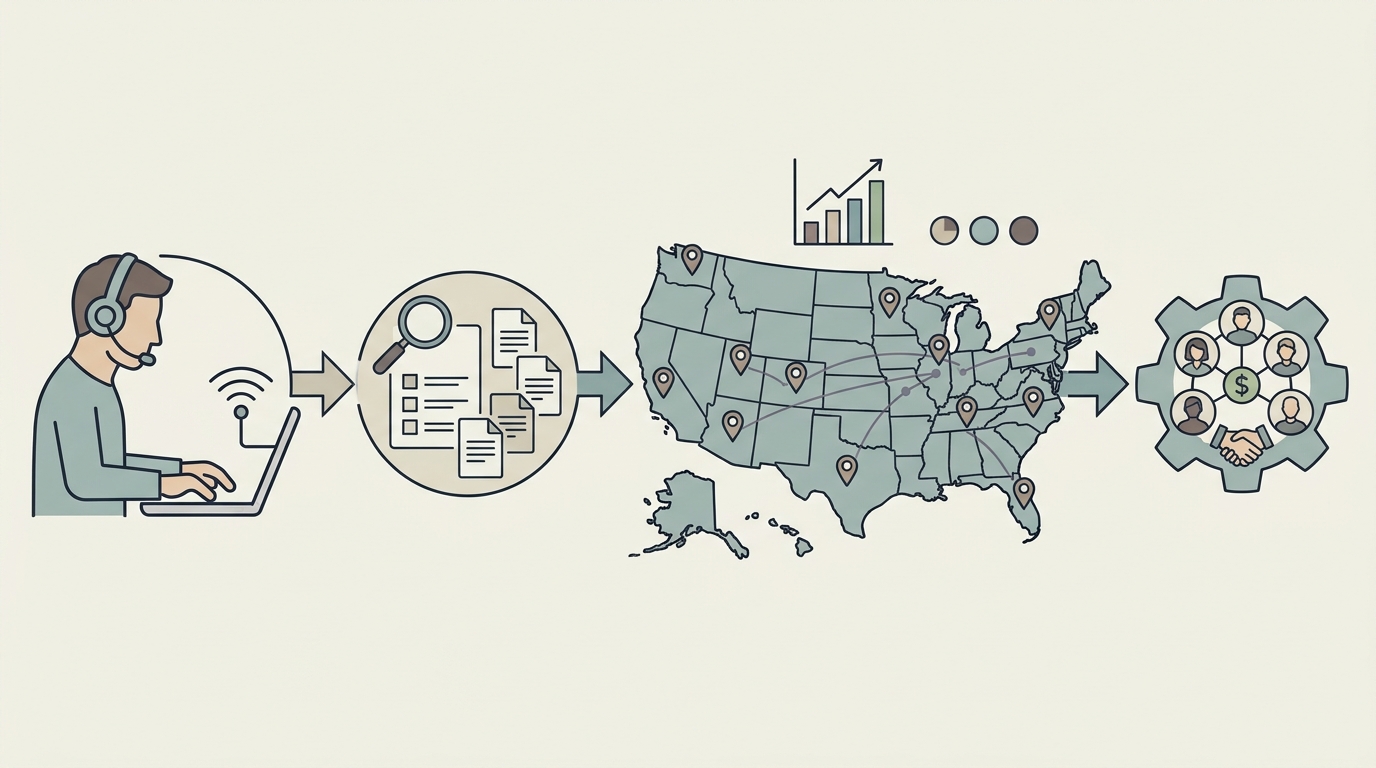
Remote Jobs Across the US Are Hiring Now — Browse Open Roles
Remote roles are posted across the US every day, but "remote" means different things: fully distributed, hybrid with occasional office days, or home-based within one state only. This guide covers what the work looks like, which employers hire remotely, how remote pay is usually structured, and the checks worth doing before you accept.
8 min read

US Jobs Are Hiring Now in 2027: See What the Work Involves and How to Start
"Hiring now" in the United States covers a wide spread of work — warehouse and logistics, customer support, healthcare support, skilled trades, retail, administration and remote office roles — and the day-to-day depends far more on the employer and the state than on the job title. Most of these roles are filled through company career pages, staffing agencies and job boards, and most are paid hourly or on a salary, sometimes with shift differentials or bonuses on top.
9 min read

Jobs in the USA Offer Career Opportunities With Competitive Pay and Benefits
Work in the United States is organised around a mix of hourly and salaried pay, employer-provided benefits, and rules that differ by state. Whether a job suits you depends less on the headline "career opportunity" than on the specific occupation: what it asks of you, what licence your state requires, and what published pay data for your area shows.
9 min read
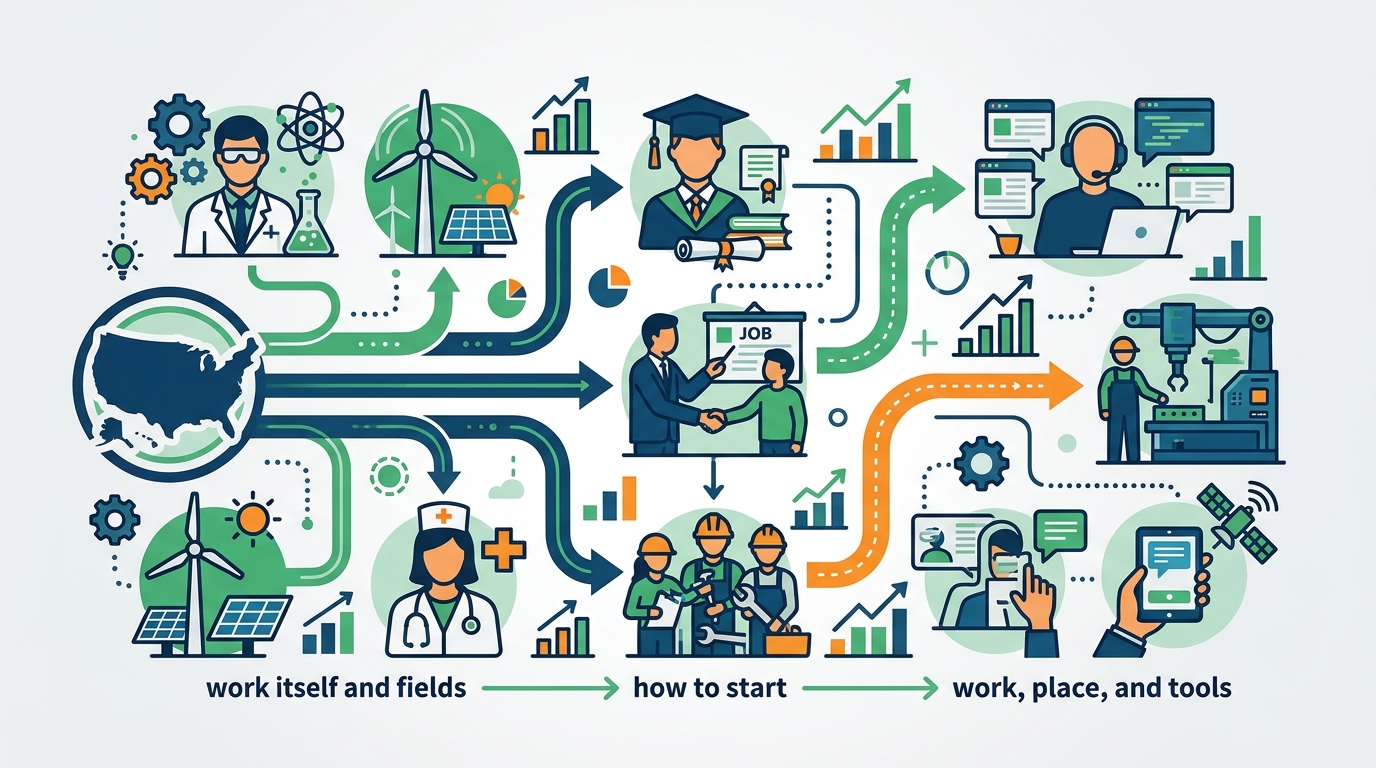
US Job Opportunities in 2027 What Work Involves and How to Start
"US job opportunities" covers a huge range of work, but the mechanics are consistent: employers hire through direct postings, staffing agencies, outsourcing firms and online marketplaces, and they pay hourly, on a salary, or per task. What changes is the occupation, the state you work in, and whether the role is on-site, hybrid or remote.
8 min read

New Job Opportunities in the United States Await You in 2027
New roles are posted in the United States every week, and 2027 will be no different — but nothing "awaits" anyone in particular. What decides your outcome is narrowing to a specific occupation, applying where that work is genuinely posted, and checking an offer properly before you sign.
9 min read

Job opportunities with competitive pay and health benefits are waiting for You!
"Competitive pay and health benefits" is a sales line, not a job title — it gets attached to warehouse shifts, call centre work, clinic support and more. The part that is actually regulated in the United States is the benefits: employers with 50 or more full-time equivalent employees must offer qualifying coverage to at least 95% of full-time employees and their dependents or face a potential penalty (HealthInsurance.org, undated), and 30 or more hours a week counts as full-time for that rule (ebm, undated).
8 min read

Full-Time vs Part-Time Jobs With Strong Pay and Benefits: How to Choose and Where to Look
Full-time usually means a set weekly schedule, access to an employer's benefits package and a predictable paycheck. Part-time usually means fewer hours, more schedule flexibility, and benefits that depend entirely on the employer and the state. The better choice turns less on the label than on three things you can check before you sign: the guaranteed hours, who pays for health coverage, and whether pay is hourly, salaried or variable.
8 min read

Looking for Full-Time/Part-Time Jobs in the USA With Immediate Hiring Options
"Immediate hiring" in the United States usually means an employer has open shifts to fill now and runs a short process: application, phone screen or walk-in interview, background check, then onboarding within days. These roles cluster in warehousing, retail, food service, delivery, customer support, caregiving, cleaning, security and temp office work, in both full-time and part-time schedules.
8 min read
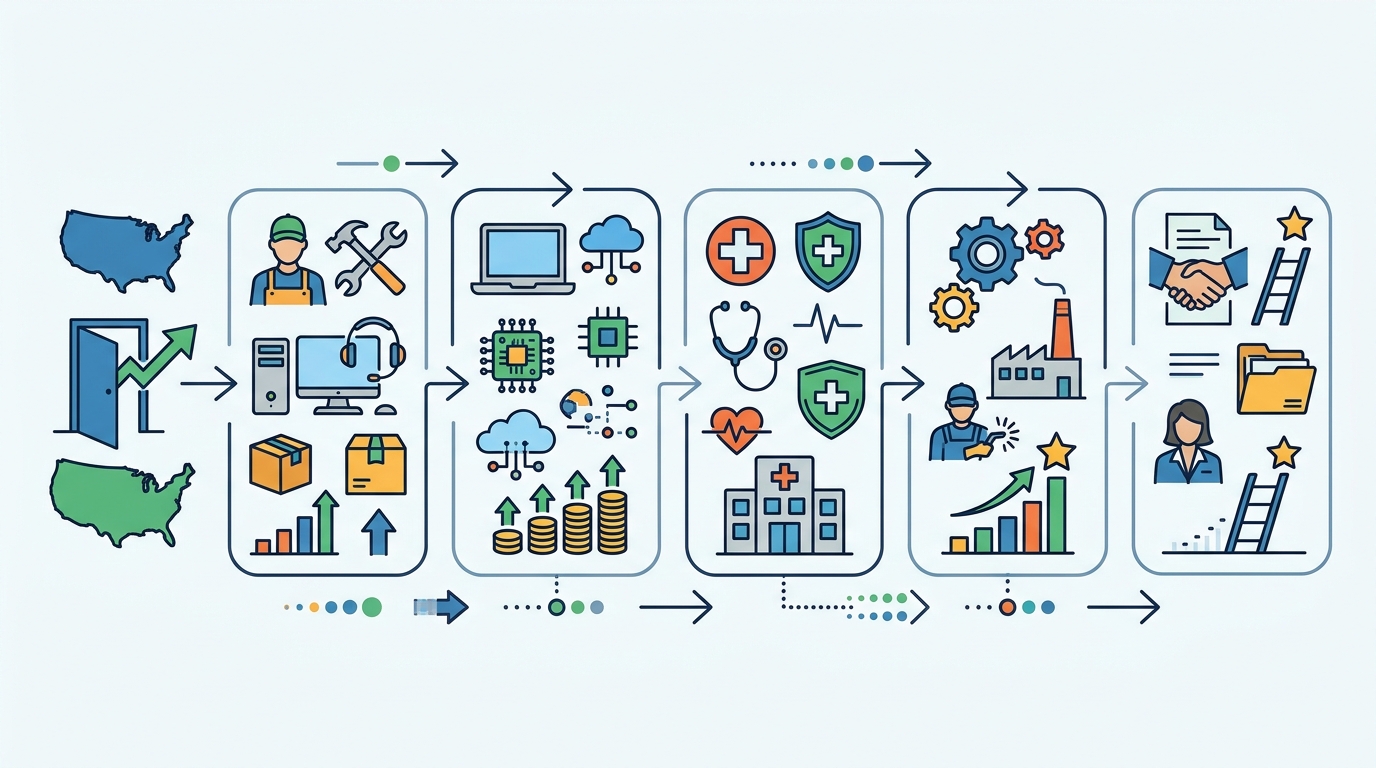
Job opportunities in the United States are waiting for you — with competitive pay, health benefits, and room to grow!
The roles advertised across the United States with "competitive pay, benefits and room to grow" are very often hand laborer and material mover jobs — loading, unloading, sorting, scanning and moving freight in warehouses, yards, docks and job sites. The U.S. Bureau of Labor Statistics (2025) reports that no formal educational credential and no prior work experience in a related occupation are typically required to enter, with training usually given on the job.
7 min read

How to Use a Staffing Agency to Find Work: Steps (With Scripts)
Using a staffing agency means registering with a branch that already has orders from local employers, passing their intake screening, and then staying visible to a recruiter until an assignment matches you. The employer generally pays the agency's fee, so there is no cost to you as a job seeker (CareerOneStop, U.S. Department of Labor, undated).
Marisol Andrade · 14 min read

8 AI Job Search Tools That Actually Save You Time
The AI tools worth your time do one boring, repeatable job in a job search: finding postings, matching your resume to a posting's language, tracking what you sent, preparing for a specific conversation, or drafting a follow-up you were going to write anyway. This guide ranks eight of them by how many minutes they save per hour of searching, after you subtract the time you spend checking their output.
Priya Shah · 14 min read

How to Answer "Walk Me Through Your Resume" (+ Example Answers)
By the end of this guide you'll have a two-minute walkthrough of your resume that you can deliver from memory, adapt to any job description, and repeat without sounding rehearsed. The question is usually asked near the start of an interview so the employer can understand how your experience translates into the role they have open (Indeed, undated) — which means it is a test of judgment about what matters, not a recital of your work history.
Sofia Bauer · 12 min read

How to Answer "Where Do You See Yourself in Five Years?" (+ Example Answers)
By the end of this guide you'll be able to give a 20- to 30-second answer that names one realistic next step, links it to the job you're actually interviewing for, and sounds like a plan rather than a wish. Interviewers are not testing your ability to predict the future — they're checking that your goals fit the role, that you're likely to stay long enough to be worth training, and that you've thought about your own progress at all.
Daniel Ortiz · 12 min read

How to Become a 1099 Independent Contractor (Steps, Skills and Pay)
You become a 1099 independent contractor by setting yourself up as a business and selling a service directly to clients. There is no application or license for the status itself: the Internal Revenue Service (IRS, undated) treats you as self-employed if you carry on a trade or business as a sole proprietor or independent contractor, including part-time or as a gig worker.
Priya Nathwani · 13 min read

How to Switch From Hospitality to Healthcare
Moving from hospitality to healthcare usually means picking one entry-level clinical role, completing a short state-approved or employer-sponsored training program, passing a competency or certification exam, and then applying with the customer-facing experience you already have. The common landing spots are nursing assistant, medical assistant, pharmacy technician, phlebotomist and EMT, and the training for them runs from a few weeks to about two years depending on the role and the state.
Ananya Rao · 17 min read

8 Signs a Job Posting Is a Ghost Job
A ghost job is a posting for a role that does not exist, is already filled, or that the employer has no immediate plan to fill — posted to build a talent pipeline, signal growth, or keep a resume pile warm (Wikipedia, undated; Texas Attorney General's office via Fox Business, undated). You cannot see inside a company's hiring system, but you can read eight signals from the posting itself, and most of them take under ten minutes to check.
Sofia Bauer · 14 min read

10 Jobs Least Likely to Be Replaced by AI
The jobs least exposed to AI so far are the ones done with your hands in places machines cannot see, and the ones where a licensed human has to sign their name to a decision. That means skilled trades, hands-on healthcare, emergency response and the supervisory roles that run a site or a cockpit.
Olu Adeyemi · 14 min read

10 Transferable Skills That Help Non-Tech Workers Break Into Tech
The skills that move people from retail, nursing, teaching, logistics or admin into tech jobs are mostly ones they already use: listening carefully, breaking a problem down, writing something another person can follow, and keeping a queue of work moving. What changes is the vocabulary, the tools and the evidence you can show a hiring manager.
Junie Castellane · 13 min read

How to Become a Veterinary Technician (Steps, Skills and Pay)
Most veterinary technicians get there the same way: finish an associate degree from a program accredited by the AVMA Committee on Veterinary Technician Education and Activities (CVTEA), pass the Veterinary Technician National Examination (VTNE), then apply for a credential from the state where you plan to work. That usually takes two to three years of full-time study, though part-time and distance programs stretch it further.
Theo Lindqvist · 12 min read

Best Careers for Stay-at-Home Parents Returning to the Workforce
The best returner careers are ones where employers hire for demonstrable skill rather than unbroken employment history: administrative and operations coordination, bookkeeping, medical billing and coding, customer success, HR and recruiting support, and skilled trades or allied health roles with defined credentials. Each of these has a visible entry point — a certificate, a licence, a portfolio or a temp placement — which matters more than the length of your break.
Desmond Okafor · 16 min read

How to Become a Welder (Steps, Skills and Pay)
Becoming a welder usually means finishing high school or an equivalent, taking a welding certificate or associate's program, passing a hands-on weld test, and then learning the rest on the job. The U.S. Bureau of Labor Statistics (2025) lists typical entry-level education for welders, cutters, solderers and brazers as a high school diploma or equivalent, with no prior work experience required and moderate-term on-the-job training.
Wei Chen · 13 min read

How to Answer "Why Do You Want to Work Here?" (+ Example Answers)
You can answer "Why do you want to work here?" well in about 60 to 90 seconds by naming one specific thing about the employer, backing it with evidence from your own work, and saying plainly what you want from the role next. The answer that fails is the one that would fit any company with the name swapped out.
Olu Adeyemi · 11 min read

How to Job Search While Still Employed: Steps (With Scripts)
Searching while you still have a paycheck is the safest way to move, but it only works if you keep the two jobs separate: nothing on company email, phones or laptops, and nothing public until you have an offer in writing. The practical work is setting your LinkedIn visibility to recruiters only, building a master resume on your own time, telling a short list of people you trust, and scheduling interviews in the margins of your week.
James O'Connor · 14 min read

How to Switch From a Federal Job to the Private Sector
Switching from a federal job to the private sector is mostly a translation exercise: the work you have done usually maps onto commercial roles, but the resume format, the vocabulary and the hiring speed are different enough that strong candidates get screened out on paper. The fastest route is to pick two or three target job titles, rewrite your federal resume into a two-page commercial one, close a single named skill gap, and talk to people who have already made the same jump.
Priya Shah · 16 min read

Call Center Interview Questions (With Sample Answers)
By the end of this guide you will know the rounds a call center interview usually has, the six things interviewers are actually scoring, and how to answer the questions that only phone-based roles get asked — handle time, QA scores, escalations and policy limits.
Junie Castellane · 19 min read

How to Become a Bookkeeper (Steps, Skills and Pay)
To become a bookkeeper you learn double-entry basics, get fluent in accounting software like QuickBooks Online or Xero, practise on a real set of books, and then apply for a clerk or junior bookkeeper role while you build toward a credential such as the AIPB Certified Bookkeeper or NACPB Certified Public Bookkeeper. No state licence is required to call yourself a bookkeeper in the US, which is why the route in is faster than most finance jobs.
Marisol Andrade · 14 min read

10 Questions to Ask When Interviewing for a Remote Job
Interviewing for remote work means checking things an onsite candidate never has to: which time zone really runs the day, whether promotions reach people who are never in the room, and whether "remote" is written into the role or sits in a policy that can change. This guide gives you ten questions to bring to a remote interview, what each answer tells you, and the questions to save for later.
Nadia Hassan · 9 min read

15 Behavioral Interview Questions for Leadership Roles (With STAR Answers)
By the end of this guide you will be able to recognise a behavioural question the moment it is asked, shape an answer using STAR, and build a bank of six to eight leadership stories you can re-cut on the spot. The 15 questions below are the ones that come up most often for supervisor, manager and director interviews, each with the competency it tests.
Priya Shah · 16 min read

What to Say When a Job Requires a Certification You Don't Have
Name the gap in plain words, say what you hold instead, and give a date you will sit the exam. That approach works when the certification is an employer preference awarded by a professional organization, because certifications are not legally required to work in an occupation (U.S. Bureau of Labor Statistics, 2016).
Desmond Okafor · 12 min read

Final Round Interview Tips: 8 Ways to Seal the Offer
By the end of this guide you will know how to prepare for a final-round interview in the week before it, what to do and say in the room, and exactly what to send afterwards and when. It is built around eight tips, each with a concrete action rather than a general instruction.
Marcus Lee · 13 min read

What to Say When You've Been Laid Off in a Job Interview
Say it early, say it short, and say it without blame: name the layoff, give one sentence of context, then move to what you want to do next. Most interviewers are checking three things — that the cut was structural, that you are not carrying a grudge, and that you can discuss it calmly. A rehearsed three-sentence answer handles all three.
James O'Connor · 12 min read

How Long Does It Take to Become a Cosmetologist?
Most people go from first day of school to licensed cosmetologist in roughly nine to fifteen months of full-time training. Part-time and evening programs usually stretch that to about eighteen months to two years. The clock is set mainly by the training hours your state board requires, how many hours a week your school schedules, and how long you wait for an exam date and license processing afterwards.
Marisol Andrade · 12 min read

Best Careers for Veterans Without a Degree
The best civilian paths for veterans without a degree are the ones that reward proof instead of paper: skilled trades, aviation and industrial maintenance, commercial driving, public safety, and cleared technical roles where a certification plus a clean background check does the work a degree does in other fields. Most take between a few weeks and two years to enter, and several — apprenticeships especially — pay you while you train.
Olu Adeyemi · 15 min read

How to Ask for On-the-Job Training: Steps (With Scripts)
Asking for on-the-job training works best when you bring a specific gap, a specific way to close it, and a plan for who covers your work while you learn. Write it down in one page, raise it verbally with your manager first, then send the same thing in writing so it can be approved, budgeted or escalated.
Priya Nathwani · 14 min read

How to Job Search During a Hiring Freeze: Steps (With Scripts)
Keep searching, but change where you spend the hours. A hiring freeze is a temporary suspension of recruitment in which open positions stay unfilled and no new roles are created, though exceptions can be granted for key positions (AIHR). Most freezes run three to six months, and some extend past a year depending on the employer's finances (Hyring), so the practical goal is to be the known candidate when the budget reopens — not to fire off applications at postings nobody is allowed to fill.
Daniel Ortiz · 15 min read

How to Become a Cybersecurity Analyst (Steps, Skills and Pay)
To become a cybersecurity analyst you usually need a working knowledge of networks and operating systems, a foundational certification such as CompTIA Security+, hands-on practice with a SIEM and packet capture, and some form of IT experience — most often a help desk, NOC or sysadmin role. Most people reach a first analyst job in roughly one to three years from a standing start, faster if they already work in IT.
Marcus Lee · 12 min read

How to Work a Job Fair: Steps (With Scripts)
Working a job fair well comes down to three things: researching the exhibitor list and setting a clear career objective before you go, delivering a short practiced introduction at the table, and following up in writing while the recruiter still remembers the conversation. CareerOneStop, run by the U.S. Department of Labor, advises not to expect an on-the-spot interview or a job offer, but to be prepared for an interview just in case.
Wei Chen · 15 min read

Best Careers for People Re-Entering the Workforce After a Career Break
The easiest careers to enter after a career break are ones that hire on demonstrable current skills and short, stackable training rather than an unbroken work history — medical assisting, bookkeeping and accounting clerk work, customer service, and computer support are four well-defined examples. Each has a published entry route, a training stage measured in months rather than years, and steady hiring demand you can check yourself in the U.S. Bureau of Labor Statistics Occupational Outlook Handbook.
Theo Lindqvist · 15 min read

10 Skills You Can Learn in a Weekend That Employers Actually Value
Ten skills below can be taken to a usable standard in roughly two days or less, and each leaves behind something another person can check: a file, a card, a recording, a repository. None of them replaces a degree or years on the job. What they do is close the small gaps that stop you being handed work.
Ananya Rao · 12 min read

How to Switch From Accounting to Data Analytics
Switching from accounting to data analytics usually means keeping your financial domain knowledge and adding three technical skills: SQL, a BI tool such as Power BI or Tableau, and enough Python or advanced Excel to clean and reshape data. Most people who do it part-time while still working take somewhere between nine and eighteen months from first SQL query to first analytics job title.
Junie Castellane · 14 min read

How to Become a Social Media Manager (Steps, Skills and Pay)
To become a social media manager, you build a public track record of running real accounts, learn the measurement and advertising tools employers use, and move in through a coordinator, assistant or internship role. The U.S. Bureau of Labor Statistics folds much of this work into public relations specialists, who typically need a bachelor's degree in public relations, communications, social science or business, and who develop social media programs to shape how an organization is seen (U.S. Bureau of Labor Statistics, undated).
Theo Lindqvist · 14 min read

Accounting Interview Questions and How to Answer Them
By the end of this guide you will know how an accounting interview is usually structured, which questions come up at each stage, and how to answer the technical ones without guessing. You will also have sample answers you can rebuild with your own numbers, systems and results.
Ananya Rao · 21 min read

10 Best Job Search Apps for Finding Work on Your Phone
The best job search app for you is the one that carries listings in your field, sends you alerts you will actually open, and lets you finish an application on a phone screen without retyping your whole work history. For most people that means one large aggregator, one network-based app, one research app, and one official source — plus a way to keep track of what you sent and when.
Sofia Bauer · 13 min read

12 Certifications That Lead to Logistics and Supply Chain Jobs
Certifications in logistics and supply chain fall into two groups: licences and cards that are legally or operationally required before you can do the work, and professional credentials that signal planning, sourcing or analysis skill to a hiring manager. The first group gets you hired fastest; the second group moves you off the floor and into planning, procurement and management roles.
Daniel Ortiz · 14 min read

10 Job Apps for Hourly, Shift and Gig Work
The quickest way into hourly, shift or gig work is usually a phone app — but the right one depends on whether you want a fixed schedule, a single shift you can pick up this weekend, or piecework you control entirely. This guide ranks ten categories of job app by how fast they move you from download to a first paid shift, and tells you what each asks for before you can start.
Marcus Lee · 13 min read

Retail Interview Questions and How to Answer Them
By the end of this guide you will know what each round of a retail interview tests, which questions you are almost certain to hear, and how to answer them with a specific example rather than a slogan. The questions below cover sales floor basics, awkward customer situations, cash and stock handling, and availability — the four things store managers worry about most when they hire.
Desmond Okafor · 20 min read

How to Ask Your Manager to Pay for a Certification or Course: Steps (With Scripts)
Asking your employer to pay for a certification or course works best as a short, written business case tied to work your team already has to do — not as a personal favour raised in passing. Find out whether a written tuition or training policy exists, price the whole cost including exam and renewal fees, name the problem the training solves, then ask your manager for a decision with a date attached.
Priya Nathwani · 13 min read

7 Government Job Search Websites Beyond USAJOBS
USAJOBS covers most of the federal executive branch and almost nothing else. State, county, municipal, school district, special district, judicial and legislative employers each run their own posting systems, and a job that never appears on USAJOBS can still be a career civil service role with a published pay schedule, a pension and a union contract.
Nadia Hassan · 12 min read

10 Industries Still Hiring in a Slow Job Market
Hiring slows unevenly. Work that is driven by regulation, demographics, safety rules or maintenance cycles keeps going when discretionary spending stalls, which is why healthcare, the trades, utilities and government-funded work usually stay active while advertising, retail expansion and venture-funded tech freeze.
Nadia Hassan · 14 min read

Explora Oportunidades Laborales en 2026: Sectores Populares y Puestos Disponibles
Entre los sectores que más puestos abren en 2026, la ciberseguridad es de los más visibles, y el papel de analista de seguridad de la información es la puerta de entrada más común dentro de él. Es un trabajo de oficina o remoto que consiste en vigilar redes, cerrar huecos de seguridad y explicarle a gente no técnica qué hacer cuando algo falla.
Marisol Andrade · 13 min read

Exploring Job Opportunities In The United States For 2026
Finding work in the United States in 2026 means running two tracks at once: the occupation you want, and the systems employers use to post, screen and verify hires. The U.S. Bureau of Labor Statistics projected total employment to grow from 170.0 million in 2024 to 175.2 million in 2034, an increase of 3.1 percent (U.S. Bureau of Labor Statistics, 2025-08-28), with healthcare and social assistance and professional, scientific, and technical services projected as the fastest-growing sectors for 2024-34 (U.S. Bureau of Labor Statistics, Monthly Labor Review, 2026).
Marisol Andrade · 8 min read